World Dual Petin-Meton Calendar
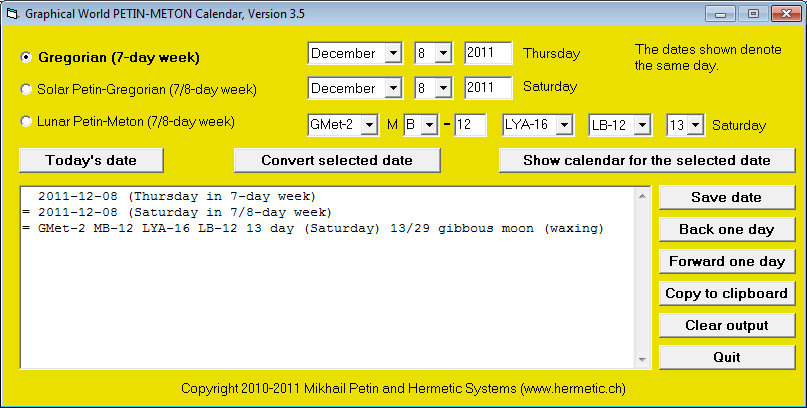
Date Conversion SoftwareThis Windows program is for converting dates in the Gregorian Calendar (a.k.a. the Common Era Calendar) to and from dates in the World Dual Petin-Meton Calendar (or "Petin-Meton Calendar" for short). The Petin-Meton Calendar is a dual calendar because it consists of two calendars: The Lunar Petin-Meton Calendar and the Solar Petin-Gregorian Calendar. Here is a screenshot of the software:
This software is copyrighted, but permission is granted by the copyright holders to download a copy of the installation program and to install the software for personal use and to study the calendar. To download the installation program (a 1,415 KB ZIP file) click on this link. Unzip the file and run 'gwpmc_setup.exe' to install the software (which, in Windows XP or 7, must be done from an admin account).
An explanation of the theoretical basis of the calendar will now be given, followed by advice as to how to use the software.
The Metonic Cycle
The Metonic cycle (discovered by the Greek astronomer Meton, 5th C. BCE) is based on the observation that 19 vernal equinox years equals 6939.60606 mean solar days and 235 synodic months equals 6939.68865 mean solar days. The difference is 0.08259 days, that is, about 1.98 hours. Thus if a full moon occurs at noon on some new year's day (in the Gregorian Calendar) then a full moon will occur close to noon on new year's day 19 years later. By distributing 235 lunations (months) over 19 years, so that 12 years have 12 months and 7 years have 13 months, a somewhat accurate lunisolar calendar can be made. But if such a calendar is to remain accurate over hundreds or thousands of years then days (or months) must occasionally be added or omitted so as to correct for the 2-hour discrepancy between 19 vernal equinox years and 235 synodic months.The Lunar Petin-Meton Calendar
The Lunar Petin-Meton Calendar, which was invented in 2001-2002 by Mikhail Petin, is based on the Metonic cycle. The fundamental periods of this calendar (other than the day) are weeks and months. Days begin at midnight local time (and end at the next midnight). Months have either 29 or 30 days. Longer periods are defined in terms of months, namely, Meton cycles, Base cycles, Hipparchus cycles, Petin cycles, Hipparchus correcting cycles and finally Grand Meton cycles.Months are of two kinds:
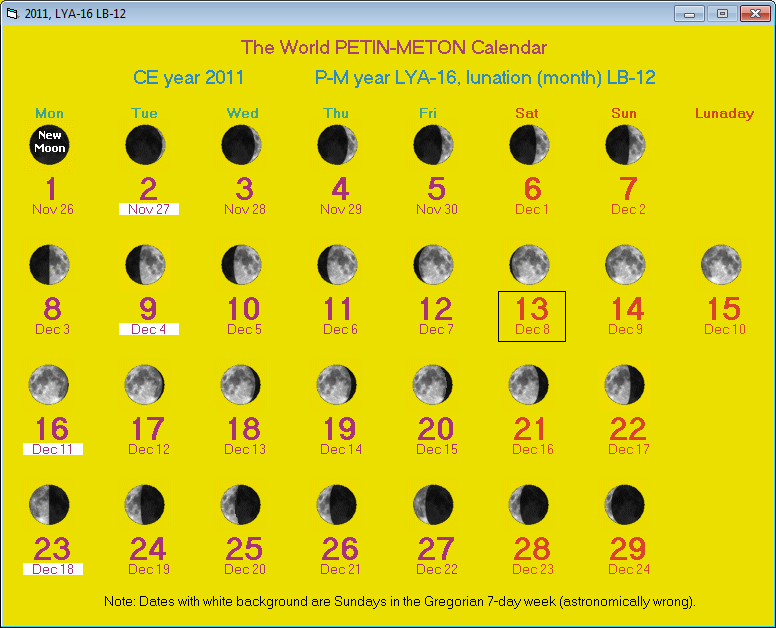
- A long month (LA) consists of 30 days and four weeks; weeks are composed of days as follows: 7 + 8 + 7 + 8.
- A short month (LB) consists of 29 days and four weeks; weeks are composed of days as follows: 7 + 8 + 7 + 7.
Click on the following link for an image of the month LB-12 in the Common Era year 2011.
The first seven days of a week have the usual names: Monday, Tuesday, ..., Sunday. When a week has eight days the last day is named Lunaday.
Years are of three kinds:
- A short year (LYA) consists of 12 months composed of alternating LA and LB months, so a short year has 354 days.
- A leap year (LYB) is the same as a short year except that the 12th month is an LA month rather than an LB month, so a leap year has 355 days.
- A long year (LYC) is the same as a short year except that it has an additional LA month, so a long year has 384 days.
Meton cycles consist of 19 years and are of three kinds:
- A long Meton cycle (MA) (containing 235 months and 6940 days) is as follows:
LYB+LYA+LYC+LYC+LYB+LYA+LYC+LYA+LYB+LYA+LYC+LYC+LYB+LYA+LYC+LYA+LYA+LYA+LYC- A short Meton cycle (MB) (containing 235 months and 6939 days) is the same as a long Meton cycle except that the first year is an LYA year rather than an LYB year.
- A correcting Meton cycle (MC) (containing 234 months and 6910 days) is the same as a long Meton cycle except that the final year is an LYA year rather than an LYC year.
A Base cycle (MetABA) consists of three Meton cycles: MA+MB+MA
A Hipparchus cycle (HA) consists of three Base cycles followed by a long Meton cycle followed by two Base cycles:
MetABA+MetABA+MetABA+MA+MetABA+MetABAA Petin cycle (PA) consists of four Hipparchus cycles: HA+HA+HA+HA
A Hipparchus correcting cycle (HC) consists of a Hipparchus cycle followed by a Base cycle followed by a correcting Meton cycle followed by a long Meton cycle: HA+MetABA+MC+MA
A Grand Meton cycle (GMet) (containing 2,366,404 days) consists of three Petin cycles followed by a Hipparchus correcting cycle followed by two Petin cycles: PA+PA+PA+HC+PA+PA
Dates in the Lunar Petin-Meton Calendar are essentially sequences of five numbers, N1-N2-N3-N4-N5, explained as follows:
- N1 is the number of the Grand Meton cycle within which the day denoted by this date occurs.
- N2 is the number of the Meton cycle within this Grand Meton cycle; a Grand Meton cycle always consists of exactly 341 Meton cycles, so 1 ≤ N2 ≤ 341.
- N3 is the number of the year within this Meton cycle, so 1 ≤ N3 ≤ 19.
- N4 is the number of the month within this year, so 1 ≤ N4 ≤ 13 (though not all years have a 13th month).
- N5 is the number of the day within this month, so 1 ≤ N5 ≤ 30 (though not all months have a 30th day).
A date contains three items of information in addition to these five numbers, namely, the type of the Meton cycle, the type of the year within the Meton cycle, and the type of the month within the year. This is illustrated by the following examples:
- GMet-2 MA-1 LYB-1 LA-1 1 day (Monday) says that this day (1786-12-20 Gregorian) occurs in the 1st Meton cycle of Grand Meton cycle #2 and this is an MA (long) Meton cycle; the day occurs in the 1st year of this Meton cycle and this is an LYB (leap) year; the day occurs in the 1st month and this is an LA (long) month; and the day is the 1st of the month, Monday.
- GMet-2 MB-12 LYC-15 LA-5 17 day (Tuesday) says that this day (2010-04-30 Gregorian) occurs in the 12th Meton cycle of Grand Meton cycle #2 and this is an MB (short) Meton cycle; the day occurs in the 15th year of this Meton cycle and this is an LYC (long) year; the day occurs in the 5th month and this is an LA (long) month; and the day is the 17th of the month, Tuesday.
- GMet-2 MA-13 LYA-2 LB-4 13 day (Saturday) says that this day (2016-03-21 Gregorian) occurs in the 13th Meton cycle of Grand Meton cycle #2 and this is an MA (long) Meton cycle; the day occurs in the 2nd year of this Meton cycle and this is an LYA (short) year; the day occurs in the 4th month and this is an LB (short) month; and the day is the 13th of the month, named Saturday.
The Lunar Petin-Meton Calendar is correlated with the sequence of observable days as follows: The first day of Grand Meton cycle #2 is December 20, 1786, in the Gregorian Calendar.
Beginning with the definition of a Grand Meton cycle, namely, PA+PA+PA+HC+PA+PA, replacing the terms PA and HC by their definitions in terms of Hipparchus cycles, etc., and replacing those terms by their definitions, and so on, leads ultimately to an expression for a Grand Meton cycle in terms of a sequence of over 80,000 LA and LB months (which are themselves defined in terms of weeks and days). Since the first day of Grand Meton cycle #2 corresponds to a specific date in the Gregorian Calendar, this establishes a one-to-one correspondence between dates in the Lunar Petin-Meton Calendar and dates in the Gregorian Calendar.
In one Grand Meton cycle there are exactly 6,479 years, 80,134 months and 2,366,404 days. This implies that the mean year in the Lunar Petin-Meton Calendar is 365.24217 days and the mean month is 29.530586 days. These values compare very favorably with the vernal equinox year (365.24238 days) and the synodic month (29.530591 days).
The Solar Petin-Gregorian Calendar
Dates in the Solar Petin-Gregorian Calendar are the same as dates in the Gregorian Calendar. The difference is that whereas the Gregorian Calendar runs in accord with a repeated 7-day week, the Solar Petin-Gregorian Calendar runs in accord with weeks which have either 7 or 8 days (with slightly more 7-day weeks than 8-day weeks). As noted above, the first seven days of a week have the usual names: Monday, Tuesday, ..., Sunday, and when a week has eight days the last day is named Lunaday. The name of a day in the Solar Petin-Gregorian Calendar is the same as the name of that day in the Lunar Petin-Meton Calendar.Use of the Software
When the above is understood then the use of the software is fairly self-evident. One of the three calendars is selected and a date in that calendar is specified by means of the drop-down lists and text boxes. Clicking on the 'Convert selected date' button will then convert the date in the selected calendar to dates in the other two calendars.If a selected date is invalid then you are informed of this. For example:
- GMet-2 MB-12 LYB-1 LA-5 17 day is invalid because
the first year of an MB (short) Meton cycle is always of type LYA not LYB.- GMet-2 MB-12 LYB-13 LB-12 10 day is invalid because
the 12th month of an LYB (leap) year is always of type LA not LB.When a selected date is valid you may move forward or back one day by clicking on the appropriate button.
A date which is displayed may be saved, in which case the program will re-display it when it is next started.
Month at a Glance
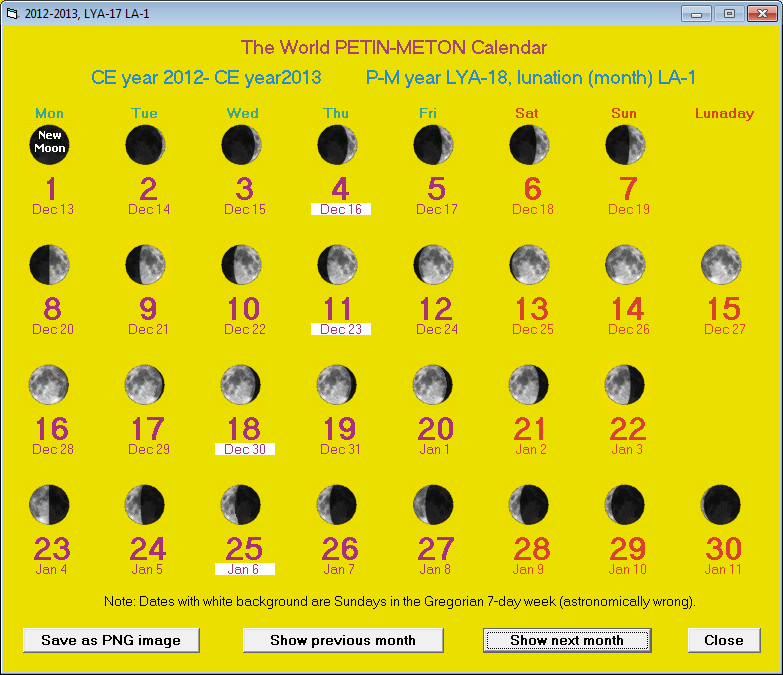
Clicking on 'Show calendar for the selected date' opens a window which displays the entire month containing the selected date, as shown in the following screenshot:
The calendar can be saved as a PNG graphics file, after you have specified the name and location of the file. (Wait until a message appears saying that the file has been saved before loading it into a viewer.)
Relevant Documents
The description of the Lunar Metin-Peton Calendar given above is based on information provided by Mikhail Petin in the Word document terms_and_symbols.doc. There is a slight difference in terminology. The Palmen cycle has been renamed the Hipparchus correcting cycle, a 'day' is termed a 'sutki' and a 'month' is termed a 'lunation'. The usual meaning of lunation is: the period between one dark moon and the next. Thus to avoid ambiguity the term 'month' has been used instead of 'lunation' in the description above.This sole inventor of this calendar is Mikhail Petin. Questions about this calendar, and requests for further information, should be sent to him at mikhlud [at] hotbox.ru.
Calendar Software Hermetic Systems Home Page