Chinese Calendrics Software Software for Chinese Calendar date conversion
and for the scholarly study of Asian Lunar CalendarsTestimonials
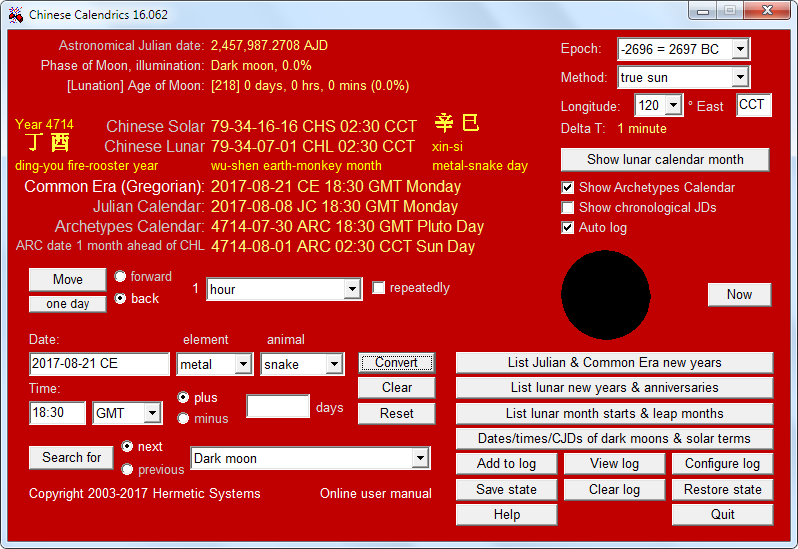
Chinese Calendrics tells you about upcoming Chinese new years and converts Chinese and European calendar dates (and also dates in the Archetypes Calendar). It provides exact times of dark moons and solar terms and is thus an indispensible tool for any serious study of the Chinese Calendar. Here is a sample screenshot:
Download the
trial version
When the cursor is over a date a small box appears with a verbose expression of that date, as shown below.
The lunar calendars used in Vietnam and Japan are the same as the lunar calendar used in China except that (a) the reference longitude is 105° E or 135° E (respectively) instead of 120° E (the Korean lunar calendar uses the same reference longitude as the Japanese) and (b) the sets of 12 animals differ slightly. The months of each year are usually the same in all three calendars, but occasionally differ. This program may be used for all three lunar calendars simply by selecting a country. The background color will change, and the names of some months, as can be seen here: Vietnamese Japanese
This Chinese Calendrics software can be used:
- To get the current date in the Chinese, Vietnamese and Japanese Calendar.
- To convert between dates in the Ch/V/J solar and lunar calendars and dates in the Common Era (Gregorian), Julian and Archetypes calendars.
- To calculate the date of New Year's Day in the Ch/V/J lunar calendar.
- To ascertain the Western dates of the starts of all lunar months in a Ch/V/J year.
- To find leap months in the lunar calendar.
- To find the Western dates corresponding to Ch/V/J anniversaries (e.g., birthdays).
- To move forward or backward from a given date (and time) either by a period such as a month (Western or Ch/V/J) or by any number of days.
- To calculate the phase of the Moon for any time within a 6000-year period.
- To search for the next or previous full moon, dark moon, lunar quarter, solar term or solstice or equinox of a certain type.
- To search for a solstice or an equinox in combination with a dark moon or a full moon.
- To search for the next or previous (relative to any given date) day , month or year with a certain element-animal correspondence (e.g., the next water-ox year or the next fire-dragon day).
- To search for the next or previous day with the same element-animal for the day and the month.
- To search for the next or previous day with a certain element-animal for the day, month and year (e.g., the next fire-dog day in a wood-rat month in a metal-ox year).
- To find days for which the element-animal is the same for day, month and year.
- To study the effect of changes in the reference longitude (105°, 120° or 135° E).
The User Manual
The user manual for this software was first published on this website on 2003-05-29 CE.
How to obtain the software: A trial version of Chinese Calendrics can be downloaded from this website. Click on the link below for further information:
Download Chinese Calendrics ...
Price and ordering: A single-user license is available for a period of 3 months, 1 year or with no time limit (a 'perpetual' license). Prices for each type of license are given at Purchase a User License. An activation key is required in order to make the trial version fully functional. An activation key can be obtained immediately if purchasing via PayPal.
![]()
Refund: A refund will be provided promptly up to 30 days after purchase if the software does not perform satisfactorily.
Updates: Purchasers of a user license for this software are entitled to an update to any later version at no additional cost.
Acknowledgements: This software was developed by Peter Meyer in 2003 and revised in 2004, 2008 and 2011. For the theory of the Chinese Calendar he relied mostly on Prof. Helmer Aslaksen's The Mathematics of the Chinese Calendar and to a lesser extent on L. E. Doggett's Calendars and Claus Tøndering's The Chinese Calendar. The dark moon times are calculated using a translation into C of a FORTRAN routine which was originally written by astronomer Robert van Gent (based on astronomer Jean Meeus's Astronomical Algorithms, Willmann-Bell Inc. Richmond, 1991, pp. 319-324 & 349-358). Thanks to Robert van Gent for providing the FORTRAN routine. The calculation of the solstices and equinoxes is based on formulas by Jan Meeus. The calculation of the times of the solar terms is based on the solstice and equinox times so calculated and on a translation into C of a FORTRAN routine for the geocentric longitude of the Sun which was also originally written by Robert van Gent.
Chinese/Vietnamese/Japanese Anniversary Dates Lunar Calendars Hermetic Systems Home Page